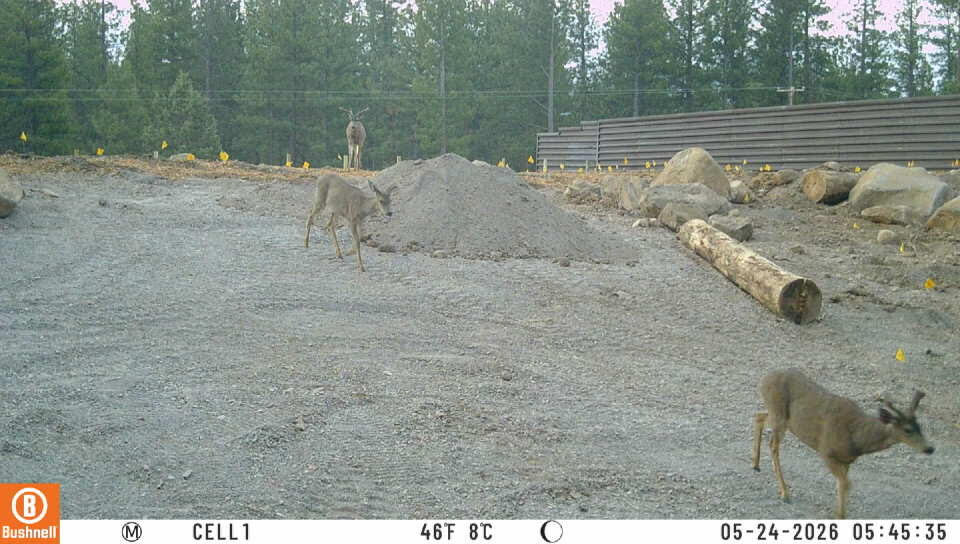
Three mule deer recently became the first animals to traipse across California’s newest wildlife bridge.
The span over two-lane US 97 in Siskiyou County, which borders Oregon, remains under construction, but cameras have already recorded crossings by the deer and a bobcat, among other animals. Meanwhile, the state is also closing in on the completion of the world’s largest wildlife crossing, a vegetated bridge that reconnects mountainous habitat that is divided by a 10-lane span of US 101 near the other end of the state.
Earlier this spring, Colorado cut the ribbon on a nearly acre-sized wildlife overpass to help elk, mule deer, and pronghorn to connect 39,000 acres of habitat that were divided by a six-lane section of Interstate 25. In May, the state also established a collision prevention fund that will fund more crossing projects.
States are expanding the infrastructure to reduce collisions between cars and wildlife and help wildlife to roam across broader expanses of habitat, now totaling more than 1,000 dedicated wildlife crossings. Researchers have established that these bridges, tunnels, and culverts can help to slash the number of crashes, and recent reports suggest that these projects often pay for themselves, sometimes within a fraction of their lifetimes.
By one estimate, adding a wildlife crossing with a 70-year lifespan to an area with moderate to high numbers of animals hit by vehicles will provide an average annual benefit of $200,000, exceeding construction costs within seven years, the firm Scioto Analysis reported last year. Such a crossing will prevent an estimated 1,400 collisions over its lifetime, saving one or more human lives, preventing injuries to 60 others, and saving 1,200 animals.
“Across a variety of different inputs and trials, we found that in the best case scenario, as many as 7,100 collisions can be prevented, 20 passenger fatalities can be avoided, and 6,700 animal deaths can be prevented from one wildlife crossing structure,” it said.
In 2023, researchers from Montana State University reported that collisions with large animals in 11 western states alone cost at least $1.6 billion per year.
The federal Infrastructure Investment and Jobs Act of 2021 established the Federal Highway Administration’s Wildlife Crossings Program, through which the agency provides funding for crossing projects. The agency announced in 2023 that it would provide $110 million in grant funding to support 19 wildlife projects in 17 states and it said in 2024 that it was awarding $125 million in grants for another 16 crossing projects in 16 states.
State lawmakers have also taken action in recent years, enacting protections for wildlife corridors and, in California, requiring that transportation officials consider how they can mitigate the impacts of infrastructure on wildlife.
The California Department of Transportation (Caltrans) said on its website that the Siskiyou County bridge site had been a hot spot for crashes involving animals, with more than 50 deer and 16 elk killed from 2015 to 2020. The recently completed overpass in Colorado, meanwhile, addresses a nearly four-mile gap between other wildlife crossings in an area that was rife with vehicle-animal collisions, averaging one per day during the fall and spring migration seasons before the wildlife crossing system had been constructed, the Colorado Department of Transportation said on its website.
“The overpass location will connect wildlife corridors and preserve open space with good proximity to water,” the agency said. “The location is also a known area for high movement of large game.”
The Utah Department of Transportation reported earlier this year that wildlife fencing alone can reduce collisions between cars and wildlife by 75 percent and crashes that injure or kill humans by 85 percent. Across the US, about 29,000 people are injured and 200 are killed in traffic collisions with wildlife each year. Costs including medical bills, vehicle damage, and increased insurance premiums total an estimated $8 billion each year.
Researchers with the Western Transportation Institute (WTI), a Montana State University-based center for rural transportation studies, noted last year that installing fences or other wildlife barriers in combination with wildlife crossing structures has been the only effective way to reduce collisions between vehicles and wild large animals such as deer and bears while still giving those animals access to habitat on both sides of the road. Fencing alone, though, can trap animals in segments of the available habitat and isolate populations, reducing biodiversity and access to food and water.
The benefits of combining broad barriers with crossing sites have been known for decades, the WTI researchers wrote, noting that studies performed more than 20 years ago showed that crashes involving large animals fell by more than 80 percent following the completion of crossing structures and fences along the Trans-Canada Highway in Banff National Park. Other research teams have since reported that collisions involving elk fell 98 percent following the installation of three crossing structures on Arizona State Route 260 and collisions with mule deer fell 81 percent following the installation of seven underpasses and fences in Wyoming.
Still, the Federal Highway Administration estimates that more than one million animals are hit by vehicles each year, resulting in about 26,000 injuries and 200 deaths. Of course, far more animals are killed in those collisions.
The WTI report authors delved into various other mitigation methods. Speed bumps, rumble strips, and overhead lighting, among other methods, can reduce collisions, but the calming methods can lead to increased noise from acceleration or the rumble strips themselves while lighting risks fragmenting habitats for species that prefer the dark.
Public education campaigns, meanwhile, may have little to no effect, and roadside warning signs tend to be ineffective unless they are time- and location-specific. Examples of effective signs include seasonal signs along mule deer migration routes or in places where bighorn sheep tend to lick road salt, and they can be additionally effective if they are enhanced with lights during peak hours of animal movement, the report authors wrote.
However, the most eye-catching signs can also be distracting, leading to more accidents. Those depicting unusual species are also frequently stolen, plus poachers may use them to target their efforts.
While animal detection systems that are paired with roadside alerts can also warn drivers and reduce crashes, they tend to be unreliable even for the detection of large animals.
Earlier this year, the Pew Charitable Trusts praised Colorado officials for providing funding to support wildlife crossings, noting that the Colorado State Patrol recorded reports of about 7,500 instances where animals were hit by vehicles in 2024 and the true number is likely higher due to underreporting. Those collisions cost about $321 million each year as well as hurt wildlife populations and the state’s outdoor economy, Pew said. However, wildlife crossings that the state completed in 2016 near Kremmling, to the west of Denver, have reduced crashes involving wildlife by 92 percent.
“Wildlife-vehicle collisions put the state’s drivers, first responders, and iconic wildlife at risk,” Pew senior manager Patrick Lane said in a statement.
Pew also noted that Utah Gov. Spencer Cox signed this year legislation that establishes $2 million in annual funding for wildlife crossing infrastructure and directs state transportation officials to provide residents with ways to voluntarily contribute additional money. About 7,000 deer in the state are hit by vehicles each year.
In the early days of the Biden Administration, the US Forest Service reported that wildlife crossing structures were proven solutions to reduce wildlife-vehicle collisions while reconnecting native habitats. The economic harm from those accidents can exceed the expense of building a crossing structure, so “it actually costs society less to solve the problem of wildlife-vehicle collisions than it costs to do nothing.”
Through a national commitment, the US could reduce the disruptive effects of its road system on wildlife, reduce the conflict that endangers people and animals, and provide a powerful gift to future generations.
“As scientific evidence of the harmful cumulative effects of habitat fragmentation, introduced invasive and exotic species, climate change, and pollution mounts, the window of opportunity to curtail our road network’s detrimental effects on wildlife is closing,” the authors wrote. “Fortunately, the foundation for a transportation system capable of coexisting with nature already exists today in the United States.”
These mule deer are the first known animals to cross California’s newest wildlife bridge. Photo courtesy of Caltrans.
 Treelines