For more than a century, the US Forest Service has cultivated lands where agency scientists study how life in the wilderness thrives and falters.
The USFS has accumulated more than 80 experimental forests and ranges since 1908, some spanning tens of thousands of acres. Agency scientists have used these living laboratories to perform long-term, landscape-scale research, with results that improve understanding of ecosystems and how forests are managed in response to the threats of climate change, diseases, invasive insects and plants, and wildfires, among other challenges.
The research facilities that serve those experimental forests are among the scientific sites that the US Department of Agriculture is evaluating for potential cuts as it moves forward with plans for sweeping changes to the USFS, with 57 R&D facilities preliminarily identified for closure so far as well as the consolidation of research leadership within a single office in Fort Collins, Colorado.
The expected cuts to the agency’s research infrastructure are part of a broader reorganization that would relocate the USFS headquarters from Washington, D.C., to Salt Lake City, close the service’s nine regional offices, and redistribute hundreds of employees. The service intends to establish the new headquarters, four new regional hubs, and 15 state-based offices that are meant to improve collaboration with local agencies.
The USFS said on its website that it expects that about 500 employees will need to relocate, mostly from the capital region, out of about 30,000 employees. USDA officials said last year that the restructuring would reduce costs, improve coordination with state agencies, and help the service to promote timber production and harvesting.
Forest Service Chief Tom Schultz said on Thursday in a hearing before a House Appropriations subcommittee that the agency has no plans to lay off researchers or end studies and it is focused on retaining scientists rather than facilities. Some of the facilities that are slated for closure are underutilized or vacant, including at least a few that are a short distance from other USFS buildings that have room for more staff.
Maine Rep. Chellie Pingree, however, said in the hearing that members of Congress have yet to see any finalized plans for the closures and relocations, the new organization structure for the agency, and the extent of staffing changes that are under consideration. She also wants to know whether the underutilized or vacant USFS facilities that Schultz described had been staffed by researchers who recently left the agency.
Pingree noted that the USFS had already lost thousands of employees with expertise on protecting forests due to the federal government’s 2025 deferred resignation program that let employees voluntarily accept months of administrative leave followed by their resignations. In an overview of the proposed FY 2027 budget, the USFS said that it had about 29,900 permanent full-time employees as of Oct. 1, which is 16 percent fewer than its 36,600 employees at the end of 2024.
Science also reported earlier this month that the USFS had lost a sizable portion of its research staff in 2025, with 137 of its 633 researchers with STEM PhDs leaving the agency.
The National Federation of Federal Employers, which represents 20,000 USFS employees, has vowed to fight the reorganization, which it characterized as an illegal reduction-in-force that is meant to dismantle critical programs and privatize the agency’s work. It estimates that 6,500 USFS employees would be affected in some way by the reorganization, of which 2,700 are research staff.
The USFS has responded that the restructuring is instead meant to move employees into the field and bring them closer to the lands that they manage. Even if the agency has no intentions of laying off its remaining research staff, though, the 2019 reorganization of the Bureau of Land Management illustrates that such reassignments can result in an exodus.
At that time, the BLM reassigned 328 employees from its Washington, D.C., headquarters to a new headquarters in Grand Junction, Colorado. The US Government Accountability Office found in 2020 that 81 had declined the transfer, and Colorado Newsline subsequently reported in 2021 that only 41 employees had actually relocated, with three accepting postings at the new headquarters.
The Trump administration has also made sharp cuts to other research operations across the federal government. Nature reported early this year that more than 7,800 research grants had been frozen and about 25,000 scientists and research-related employees had left the government since January 2025.
Among USFS research projects in recent years, the agency’s scientists have performed myriad studies on the impacts of climate change and methods to mitigate its harms, whereas President Trump has dismissed climate change as a hoax. Taking an axe to USFS’ research capabilities, though, risks indirect harm to the industries that the administration seeks to help since the agency’s studies have long been used to help improve the resilience and regrowth of the forests as well as the methods for selecting and using trees for lumber.
That includes long-term studies on water use, invasive pests, wildfires, and air pollution impacts. Many of the long-term studies are conducted in experimental forests, which have been operating almost since the USFS’ inception in 1905.
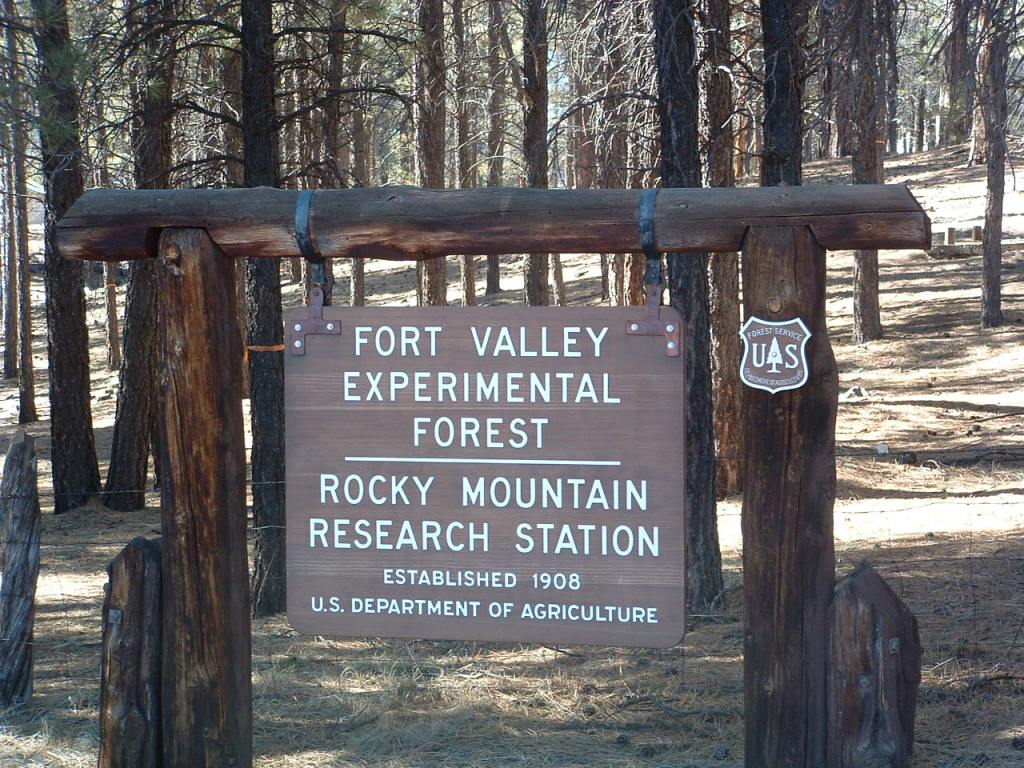
By 1908, the nascent USFS had established its first experimental forest, Fort Valley, in an isolated area near Flagstaff, Arizona. The agency selected the site to help a pair of Arizona lumbermen investigate why stands of ponderosa pines were not recovering after logging.
The agency notes on its website that the meteorological observations that began during those early years have aided investigations into the effects of climate change a century later. Fort Valley researchers have in recent years further delved into the impacts of climate change on the region’s plant populations, showing how shifts in patterns of wildfires and droughts can affect tree species and the effects of long-term forest thinning programs on the survival of stressed populations of ponderosa pines, among other results.
Scientists at other sites have delved into methods of rehabilitating exploited lands, adopting more sustainable forestry, and improving wood harvests. In the southern tip of Illinois, for example, USFS scientists at the 1,150-acre Kaskaskia Experimental Forest study changes to tree populations across decades, the management of forests using various cutting methods and time periods between those treatments, and methods to improve hardwood harvesting.
Schultz said on Thursday that the agency intends to retain its experimental forests. But Pingree noted that members of Congress are grasping for answers, and She also said that she is worried that the administration is trying to shift a rising number of responsibilities to states including not only forestry but also environmental protection and nutrition assistance.
Maine lacks the resources to take over all of the functions of the federal government, she said, and forest services might not be the top priority if it has to choose which of those functions to take on.
Until the agency publishes a detailed plan, though, Congress and states will remain in the dark about the extent of the changes under the reorganization and how much the federal government expects that states, universities, and the private sector will step up to fill in the gaps.
Photo courtesy of the US Forest Service