An aggressive, fast-growing bush is taking over groves of protected forests around Chicago, slowly creating a monoculture.
In Cook County alone, conservation officials and volunteers each year clear about 1,000 acres of European buckthorn as well as other invasive bushes that have degraded wild landscapes. While they are chipping away at the invasion, they expect only to manage or contain the problem rather than to eradicate it.
Buckthorn is the most pervasive of the invasive shrubs that are choking out native saplings, flowers, and ephemerals in the region, far more than competing invasives such as bush honeysuckle and round leaf bittersweet. Beneath the broad canopies of silver maples, black walnuts, and white oaks, buckthorn forms dense thickets that shade out any would-be competitors, leaving barren ground where food-giving understory plants and the next generation of saplings would normally thrive in the dappled sunlight.
At last count, researchers from the Morton Arboretum in Lisle, Illinois, reported in 2020 that European buckthorn had become the most abundant tree in the seven-county area, accounting for 36 percent of tree stems and 10 percent of leaf cover. Since a previous census in 2010, the buckthorn population had grown by 41 percent, to 63.4 million stems, while the honeysuckle population rose 114 percent, to 10.5 million stems.
Lindsay Darling, researcher at Morton Arboretum and one of the authors of the 2020 Chicago Region Tree Census, said that the spread of invasives seems to be worsening with expansion into more of the region’s wilderness. In study results published last year in Urban Forestry & Urban Greening, she and coauthors from Purdue University and the University of Illinois used LIDAR-based measurements to determine where invasive shrubs had taken hold and they found that invasive shrubs have taken over at least part of the understory in an estimated 77 percent of Chicago-area forests.
The researchers analyzed the height and consistency of forest canopies and found that they could identify the presence of invasive shrubs with 93 percent accuracy.
Darling said that forested plots with non-native shrubs have more dense, homogenous canopies whereas a typical forest of native species has a canopy that is riddled with holes that allow sunlight to break through, supporting more ecological niches and a higher-quality ecosystem. The forests that are dense with non-native species, meanwhile, are struggling because the ground beneath buckthorn or bush honeysuckle is devoid of understory plants.
“It’s just bare soil, and that’s because they grow so dense that no light reaches the floor,” she said.
Buckthorn had been introduced to the US in the 1800s as an ornamental plant, likely for the same reasons why it is tough to fight today. It grows well in full sun or shade, produces dense thickets, resists pests endemic to the continent, and retains its leaves almost two months longer than comparable native bushes. As birds spread buckthorn’s berries, it became a nuisance in the US Midwest and Northeast.
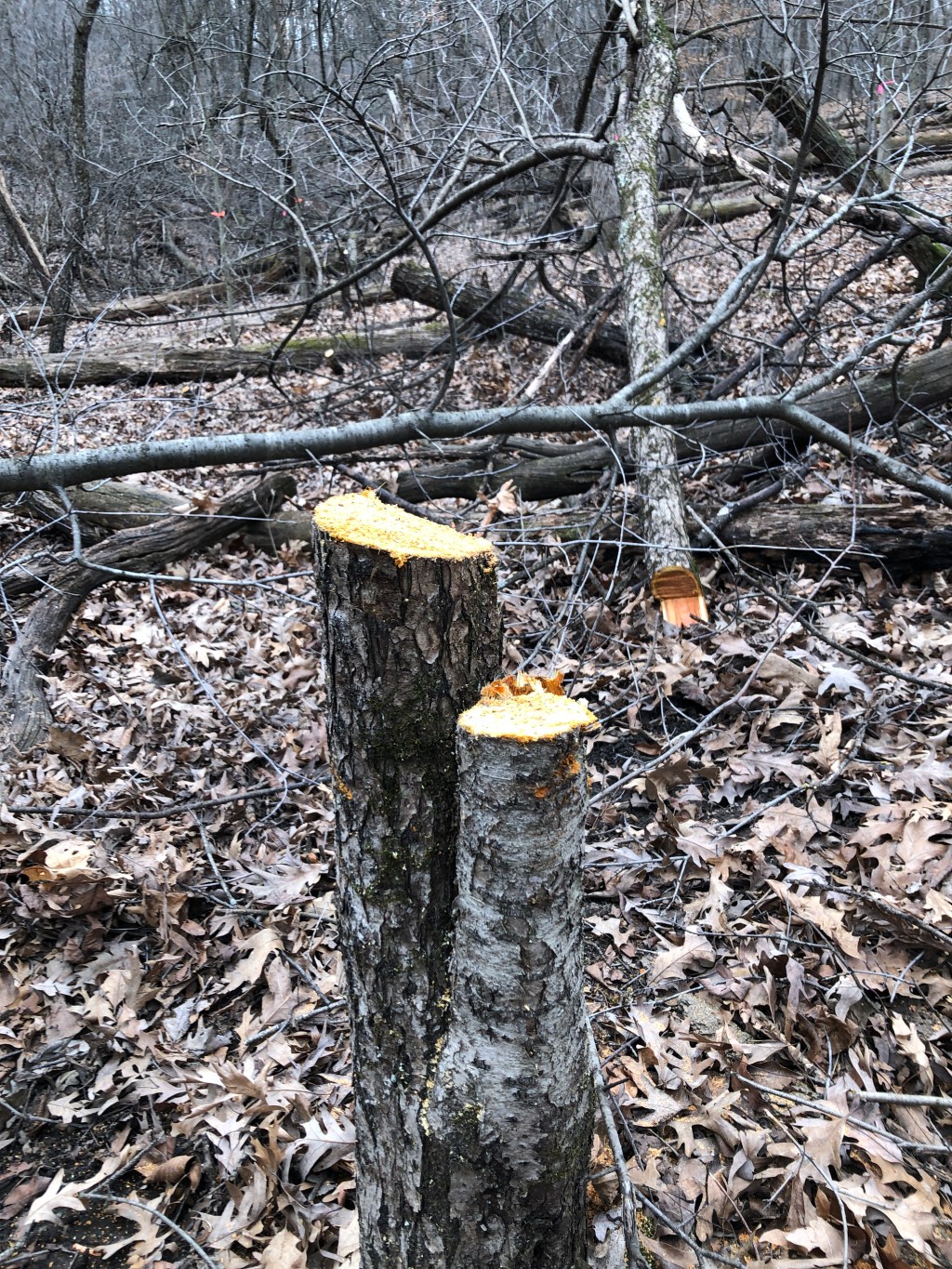
On an unseasonably warm Valentine’s Day, I was one of about 20 volunteers who helped to chop down and burn crowded stands of buckthorn from a wooded section of Deer Grove Forest Preserve in the Chicago suburb of Palatine. Armed with bow saws and loppers, we cut and burned clusters of the small- and mid-sized shrubby trees in the county’s oldest forest preserve, leaving behind orange-ringed stumps that could be easily found later for targeted pesticide spraying.
We cleared a few acres in each of the following weekends. The airy, spacious woods where we had worked bordered a ragged line of intertwined branches that remained overrun.
Troy Showerman, resource project manager for the Forest Preserves of Cook County, said that removing non-native shrubby brush is his primary focus from November through March. Buckthorn species in particular can not only outcompete native vegetation that feeds wild animals but also contaminate the surrounding environment. He noted that previous study results show that the decomposing buckthorn leaves and berries can release the metabolite emodin, which is harmful to frogs and salamanders and may be connected with amphibian declines.
It’s also known to alter soil composition, further hindering competitors.
However, Showerman said that the forest preserve district aims to clear about 1,000 acres of brush each year, and it could surpass 19,000 acres that are cleared by the end of 2026.
“This winter, we’re probably actually going to exceed that,” he said. “We’ve got a pretty good winter for work with both funding and weather cooperating in 2026.”
That funding includes $6.3 million that voters approved for ecological restoration as part of a larger referendum that passed in 2022.
As for Deer Grove, about 600 acres of the nearly 2,000-acre preserve has been cleared of invasive brush so far, mostly through work that was funded over the past decade by a project to replace wetlands that were lost during an expansion of O’Hare International Airport.
The county system has about 58,000 acres of natural areas that are potentially affected by invasive shrubs, Showerman said. Maintaining progress requires 3-5 years of follow-up work including targeted pesticide application and prescribed fires, and the district is stretched further as it makes more progress, he said.
“I do think we’re making huge inroads,” he said. “A thousand acres is not a small number, but at the same time, we still have a ways to go.”
Darling noted that invasive shrubs also can be subdued or eradicated at specific sites through management, as the Morton Arboretum and the Chicago Botanic Garden have shown, even if the plants aren’t eliminated from the region. That requires prioritizing areas that have the most ecological value and maintaining them through methods including prescribed burns and the planting of native shrubs. Otherwise, the invaders will reemerge from the seed bank.
“When we put in the time and the effort, we can make it go away,” she said.
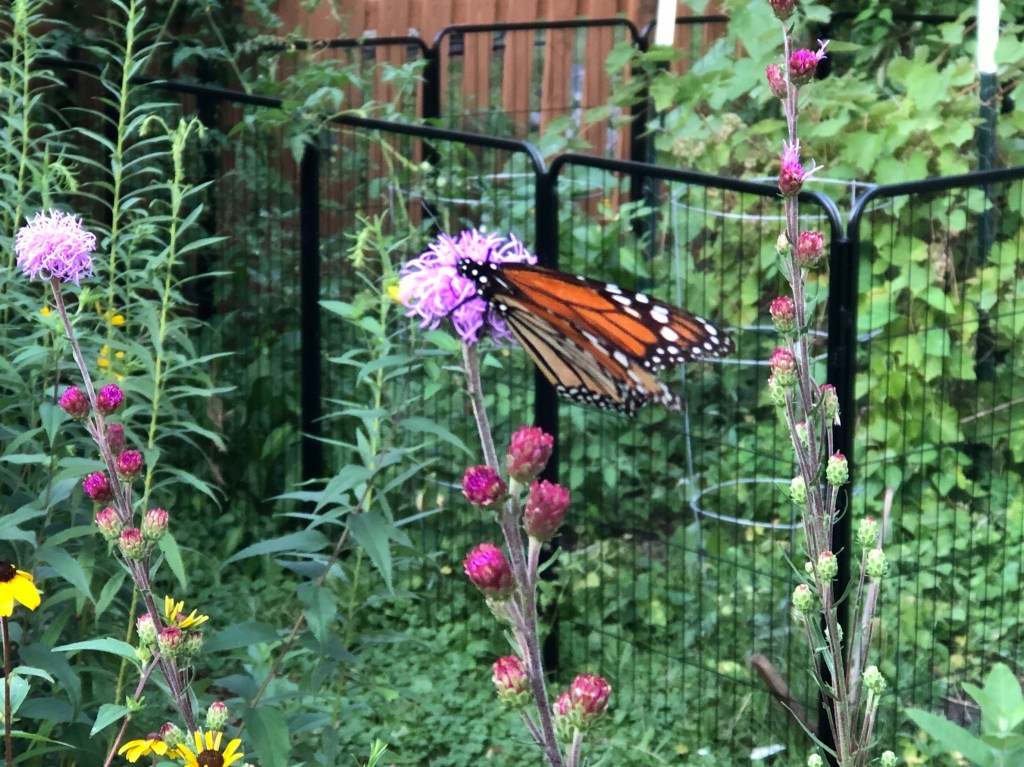
Showerman said that homeowners can help by knocking down the invasive plants along fencelines and within hedgerows, especially if they live next to natural areas. Replace them with plants that provide homes for native insects and flowers to pollinate, he said.
“Be careful with what you’re planting at your home,” he said. “Try to focus on species that are native.”
He said that it’s unrealistic to expect that people can remove all buckthorn from the Midwest with current methods, and intensive management can be frustrating. However, the work provides huge benefits to wildlife.
After my second weekend clearing buckthorn at Deer Grove, I was embarrassed to find a small buckthorn tree in my own quarter-acre yard, planted in a decorative barrel by a previous owner. The bright orange flesh beneath the moss-covered gray bark confirmed my suspicions, and the logs are now stacked next to our burn pit.
Darling hopes that her research can also help show where forests are overrun by non-native plants and aid decisions on where to intervene. While it may be discouraging to hear that more than three quarters of the area’s forests are rife with invading plants, she said that awareness of the problem can also give people a push to help out at home or as volunteers on public lands.
“We’re not going to win this battle, but we can’t lose it,” Darling said.
 Treelines