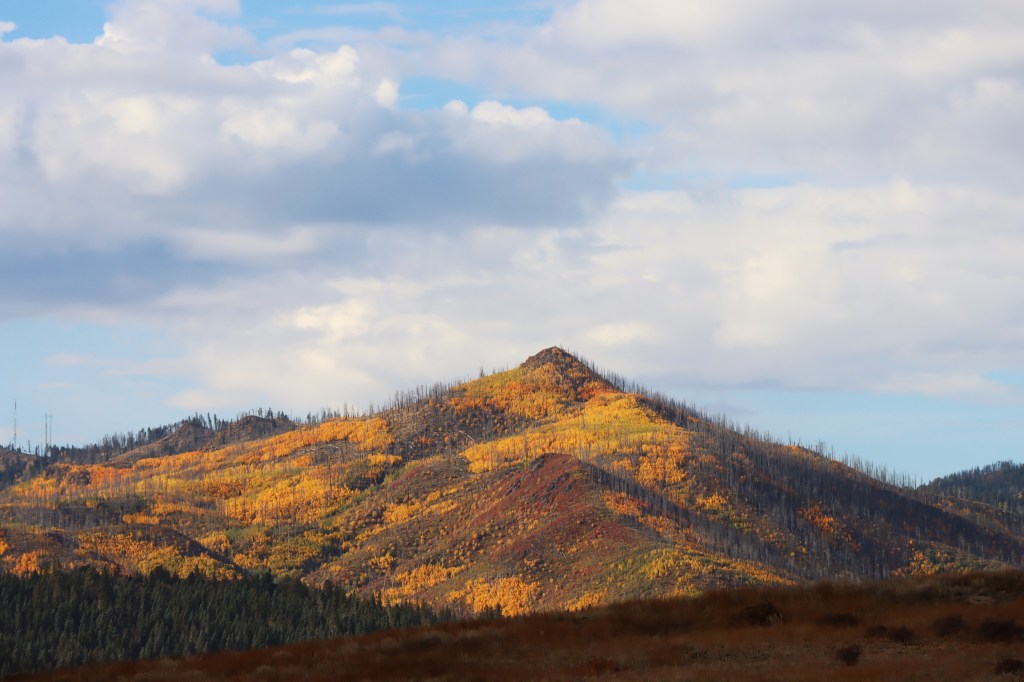
As forest managers clear overcrowded stands of trees to reduce the risks of dangerous wildfires, a greater diversity of insects can emerge in the sun-bathed regrowth.
Researchers from the US National Park Service and the University of New Mexico recently reported in Forest Ecology and Management that 18 grasshopper species and three cricket species colonized and thrived in the meadows that emerged during and after five years of thinning, controlled burning, and regrowth in the Valles Caldera National Preserve, up from only two of those cricket species that were abundant under forest canopies. The researchers conducted the study in a mixed-conifer forest within the Jemez Mountains in northern New Mexico.
“The forest restoration treatments of thinning and burning resulted in altered abiotic and biotic variables (changes in microclimates, tree stand characteristics, forest floor vegetation, litter, exposed mineral soil and coarse woody debris) that created a mosaic of habitat resources conducive to supporting the new community of orthopteran species,” the authors said.
The insects that found homes in the new meadow likely spread from nearby residual meadows and the habitats alongside logging access roads, they said.
In 1935, the 112-acre study area had been a grassy meadow with scattered old-growth ponderosa pine and Douglas fir trees, the authors wrote. Trees had since filled in the area, and it was slated for restoration through the removal of spruce and fir trees and retention of scattered fir, pine, and aspen trees. The forest gaps were intended to create a fire break.
Forest managers use forest thinning to reduce overcrowding that stresses trees and increases the risk of hotter and longer-burning fires than could occur naturally. Low-intensity fires, in contrast, are essential for healthy forests.
The authors of the Forest Ecology and Management article noted that fuel loads have accumulated in forests since the late 1800s due to fire prevention efforts and the removal of fuels outside the forests by livestock.
The researchers collected more than 43,000 grasshoppers and crickets using pitfall traps constructed of plastic cups that were half filled with propylene glycol and shielded from rain and animal disturbance by ceramic tiles and steel mesh. Over six years, 2017-2022, the researchers operated the traps for four months per year beginning in early June, with collection from the traps at the end of each month.
The samples were collected from the treatment area and an untreated mixed-conifer forest, and the researchers sorted and counted grasshoppers and crickets by species, sex, life stage, and body length.
They identified 21 orthopteran species in the treated area compared to 11 species in the control area. A single species of camel cricket, Ceuthophilus utahensis, accounted for about 69 percent of total specimens collected in the treated area compared to 99.5 percent of those collected in the control area.
The change fit with predictions in prior literature that forest disturbance would support grasshopper species with good flight and dispersal capabilities whereas closed-canopy forests support local and ecological specialist cricket species, the authors noted.
During the study period, the tree canopy cover in the treated area was reduced to 38 percent from 72 percent prior to treatment and the live tree densities were reduced to 68 per hectare from 1,040 per hectare, excluding seedlings. Meanwhile, herbaceous ground cover by grasses, sedges, and forbs, among others, eventually increased to 96 percent from 62 percent prior to thinning, with much of that change due to the proliferation of the native Thurber fescue and non-native Kentucky bluegrass.
The study authors recommend that forest managers continue to use tree cutting with controlled burns to create a mix of habitats that provide homes to a greater variety of species including grasshoppers, crickets, and the animals that eat them.
Photo courtesy of NPS/Lauren Ray

 Treelines